
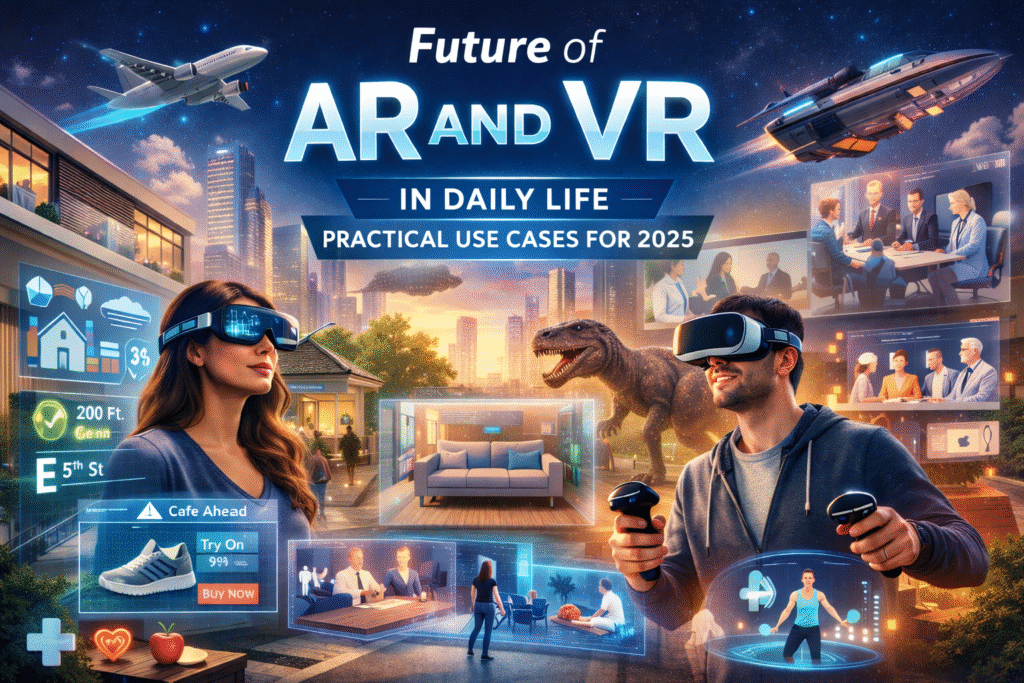
Introduction: Future of AR and VR
The future of AR (augmented reality) and VR (virtual reality) is fast turning into a reality. These technologies, as soon as constrained to video games and amusement, are actually expanding into everyday life. From education and healthcare to clever houses and leisure, AR and VR use instances are becoming essential to enhance efficiency, usability, and person experience.
By 2025, AR and VR will not only enhance the way we play or store, but can also redefine everyday activities, making our lives smarter and extra immersive. This article explores the practical methods AR and VR will affect regular lifestyles, helping you realise their full potential.
1. Future of AR and VR in AR in Everyday Navigation and Travel
Navigation is one of the first areas where AR adjusts day-to-day life. Instead of constantly searching at your smartphone, AR glasses will overlay directions immediately into your discipline of vision.
Practical AR and VR use instances for the journey:
- Walking or driving guidelines are predicted in real time
- Fast translation of avenue signs and symptoms when journeying abroad
- Indoor navigation in purchasing centres, airports, and hospitals
- Real-time site visitors indicators and alternative direction hints
Advantages:
Travel is becoming more secure, faster, and more interactive. Users save time and avoid distractions from checking maps on the telephone. Learn more about AI tools for AR and VR
2. Future of AR and VR in Virtual Shopping: A New Retail Experience
Shopping is being converted with the aid of AR and VR. Retailers now offer immersive reports that allow clients to discover merchandise without leaving home.
Use cases:
- AR Try-On: Try on clothes, accessories, or shoes sincerely
- VR Store: Walk across the digital mall, browse merchandise, and go to checkout
- Furniture placement: Use AR to see how sofas, tables, or decor fit into your room
- Real-time product comparison shown through clever glasses
Advantages:
Customers buy with confidence, returns are decreased, and shopping will become interactive and tasty.
Learn more from Wired AR & VR articles.
3. Future of AR and VR in Smart Homes Powered by AR
Mart houses will integrate AR technology to make manipulation and upkeep simpler.
Application:
- Monitor energy use in real time via AR overlays
- Visualise hidden wiring and plumbing for repairs
- Access AR tutorials to excellent-track gadgets
- See a digital walkthrough of a home layout earlier than production
Advantages:
- Saves time and reduces mistakes
- Make DIY initiatives on hand for novices
- Simplifies housing administration and interior planning
Explore Smart Home Technology Trends in 2025
4. Future of AR and VR in Healthcare

Healthcare is one of the fastest-developing areas for AR and VR. From surgical treatment to patient care, these technologies improve accuracy and training.
Application:
- AR-assisted surgical treatment with real-time 3-D overlay
- VR programs for mental fitness remedy (stress, PTSD, anxiety)
- AR health monitoring for coronary heart rate, blood pressure, and hydration
- VR education for scientific personnel in a secure, managed environment
Advantages:
Patients acquire quicker, more secure, and greater accurate remedies. Medical specialists can successfully teach real sufferers without danger. Explore Statista AR/VR healthcare data
5. Future of AR and VR in Education: Immersive Learning Experiences
AR and VR remodel gaining knowledge by way of making it interactive and tasty. Traditional textbooks are supplemented with three-D fashions and virtual reviews.
Example:
- VR tours to ancient websites, outer space, or underwater worlds
- AR science experiments without a lab device
- VR abilities schooling for medical, engineering, and aviation
- AR-enabled classroom lessons with holograms
Advantages:
Learning will become sensible, deep, and clear to recognise. Students retain data more and develop practical competencies more quickly.
6. Future of AR and VR in Remote Work and Virtual Offices
AR and VR are redefining faraway work, making virtual meetings and offices more realistic.
Use cases:
- Virtual assembly rooms feel like actual office space
- VR workstations emulate a couple of presentations
- Holographic collaboration for architects, designers, and engineers
- Virtual team constructing a workout
Advantages:
Remote running turns into extra efficient, collaborative, and engaging. Employees sense extra relatedness regardless of the space.
7. Fitness and Gamified Workout
Training routine will become exciting with AR and VR integration.
Example:
- VR biking via mountains, beaches, or myth worlds
- AR private trainers provide real-time guidance
- VR meditation and intellectual well-being periods
- Gamified workout routines turn the workout right into a fun interest
Advantages:
Home schooling is more interactive, motivating, and varied.
8. Future of AR and VR in Entertainment and Media
AR and VR bring subsequent-stage enjoyment to our homes.
Trends:
- VR movies with immersive experiences
- AR concert at home with a 3-D hologram
- VR theme parks that offer exciting adventures
- Personalised interactive storytelling
Advantages:
Entertainment will become hyper-private, immersive, and unforgettable.
9. Socialising in Virtual Spaces
Digital social interactions increase beyond messaging and video calling.
Application:
- Virtual events and worldwide meetings
- AR avatars in real environments
- VR club and networking area
- Long-distance family gatherings via VR
Advantages:
People connect and have interaction more meaningfully, so that distances can be covered without difficulty.
10. Future of AR and VR in Daily home tasks
AR makes normal tasks smarter and less complicated.
Use instances:
- Cooking publications are covered in AR, displaying step-by-step commands
- Smart labels that show the meals’ expiry dates
- AR measuring tool for protection tasks
- VR education to examine new abilities
Advantages:
Everyday existence will become green, satisfactory, and destiny-oriented.
In Conclusion:
The destiny of future AR and VR in everyday existence is vivid and realistic. By 2025, that technology will redefine the manner in which we work, research, store, socialise, and be entertained. They boost productivity, creativity, and ease of use at the same time as making ordinary stories extra immersive.
CTA Future of AR and VR
Ready to explore the future of technology?
Stay connected with SmaTechs for expert insights on AR, VR, Artificial Intelligence, and emerging technologies shaping daily life.
Visit our homepage to discover the latest tech trends, practical guides, and future-focused content:
Pingback: AI in Healthcare 2026: Powerful Ways AI Is Revolutionizing Patient Care
Exaculty! AI deiven personlized healthcare is the future. Integrating AR/VR can further enhance patient outcomes and medical training. Great Ponit!