Introduction
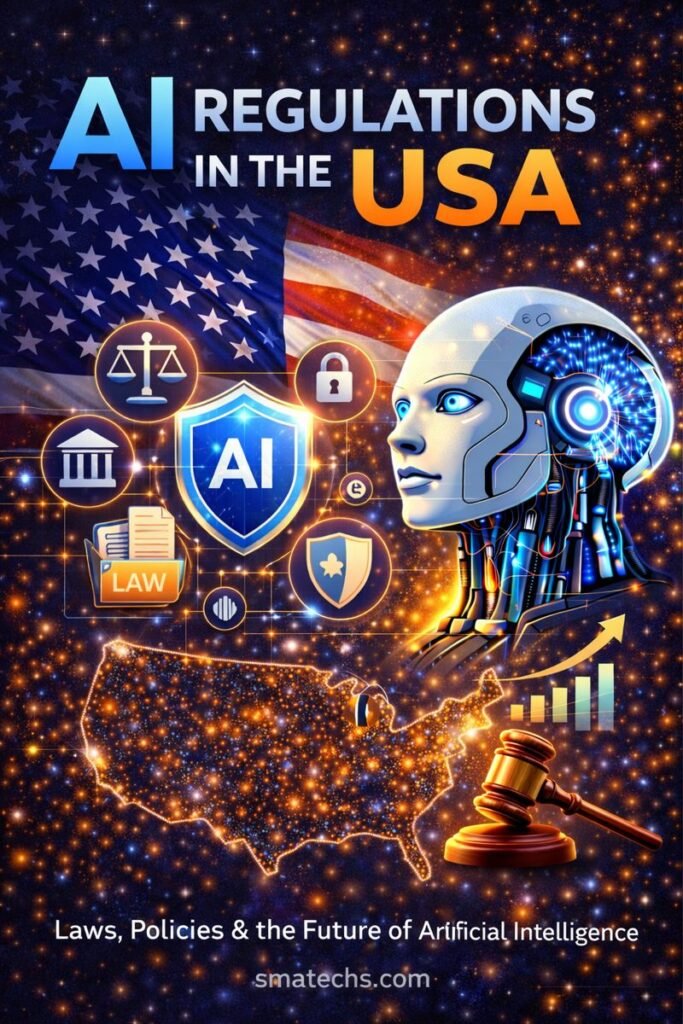
AI Regulations in the USA
Artificial intelligence is developing rapidly across the United States, transforming industries consisting of healthcare, finance, advertising, and transportation. With this rapid boom, AI regulations have emerged as a crucial subject matter within the United States. The US government is working to stabilize innovation with security, privacy, and moral duty.
As AI systems grow to be more effective, clean regulations are vital to protect users, make sure fairness, and prevent abuse. In this article, we can discover contemporary AI legal guidelines, government guidelines, challenges, and the future of AI law in the United States.
Why AI Regulations Are Important in the USA
AI policies require: AI Regulations in the USA
- Protect consumer statistics and privacy
- Prevent bias and discrimination
- Ensure transparency in AI decisions
- keep country-wide security
- Promote accountable innovation
Without proper regulation, AI can create extreme moral, criminal, and social troubles.
Current AI Regulations in the USA
Unlike a few countries, the US does not yet have a single, uniform AI regulation. Instead, AI is regulated through current laws, government orders, and employer policies.
1️⃣ The White House AI Executive Order
The US authorities issued an executive order targeted at:
- Safe and stable AI development
- Protection of client privacy
- Reduces AI Bias
- Encourage responsible AI innovation.
👉 https://www.whitehouse.gov/ai/
2️⃣ Data Privacy Laws
AI structures depend on records. Several US laws help adjust the use of records:
- California Consumer Privacy Act (CCPA)
- Health Insurance Portability and Accountability Act (HIPAA)
- Children’s Online Privacy Protection Act (COPPA)
These legal guidelines indirectly influence AI by controlling how data can be collected and utilized.
3️⃣ AI in Healthcare Regulations
In healthcare, AI equipment is regulated through the FDA (Food and Drug Administration).
AI structures are used to: AI Regulations in the USA
- Clinical diagnosis
- Photograph analysis
- Scientific decision helps
- Strict safety and accuracy standards must be met.
AI Regulations by Industry
🔹 AI in Finance
Financial establishments have to comply with:
- Truthful lending regulation
- Anti-discrimination rules
- Necessities for transparency
AI-based structures for credit scoring and fraud detection are closely monitored.
🔹 AI in Marketing & Advertising
AI tools used to target commercials should follow:
- The Consumer Protection Act
- Regulations for privacy
- Ethical marketing practices
👉AI for Digital Marketing
🔹 AI in Employment
AI hiring equipment to avoid: AI Regulations in the USA
- Prejudice is primarily based on race, gender, or age
- Uautomated selections
Several US states are introducing policies to overtake AI recruitment structures.
Ethical AI Guidelines in the USA
Beyond laws, many businesses adhere to ethical AI principles:
- Openness
- Accountability
- Impartiality
- Human inspection
- Explainability
Technology businesses such as Google, Microsoft, and IBM have their own AI moral frameworks.
Challenges in Regulating AI
It isn’t easy to regulate AI. Major demanding situations consist of: AI Regulations in the USA
❌ Rapid AI innovation
❌ Lack of technical know-how amongst legislators
❌ Balance innovation with manipulation
❌ Global AI opposition
❌ Different rules in the country degree
The US aims to modify artificial intelligence without slowing technological improvement.
How AI Regulations Affect Businesses
Companies using artificial intelligence in the US need to:
- Comply with records safety laws
- Ensure AI transparency
- Monitor AI Bias
- Document AI selection making
Companies that forget about AI regulations are at risk:
- Heavy high-quality
- legal motion
- lack of consumer self-belief
Future of AI Regulations in the USA
The future of AI regulation inside the US is expected to encompass:
- Strong federal AI legal guidelines
- Mandatory AI chance assessment
- Clear guidelines for generator AI
- AI Accountability Standards
- Increase in audits of AI structures
In 2026 and beyond, the AI regulations become extra structured and industry-specific.
AI Regulations vs Innovation: Finding the Balance
The American technique makes a sspecialtyof:
- Encourage AI innovation
- Shield civilians
- keep worldwide management
Instead of harsh sanctions, the United States prefers guidance, transparency, and duty.
Final Thoughts: AI Regulations in the USA
AI regulation in the USA is evolving to make certain that synthetic intelligence is secure, ethical, and useful for all. While the guidelines are still evolving, organizations and people should stay knowledgeable and compliant.
Adoption of clever AI starts with responsible use. Understanding AI guidelines nowadays will help you reach tomorrow’s AI-driven future.
👉 Stay up to date with clever generation insights right here: